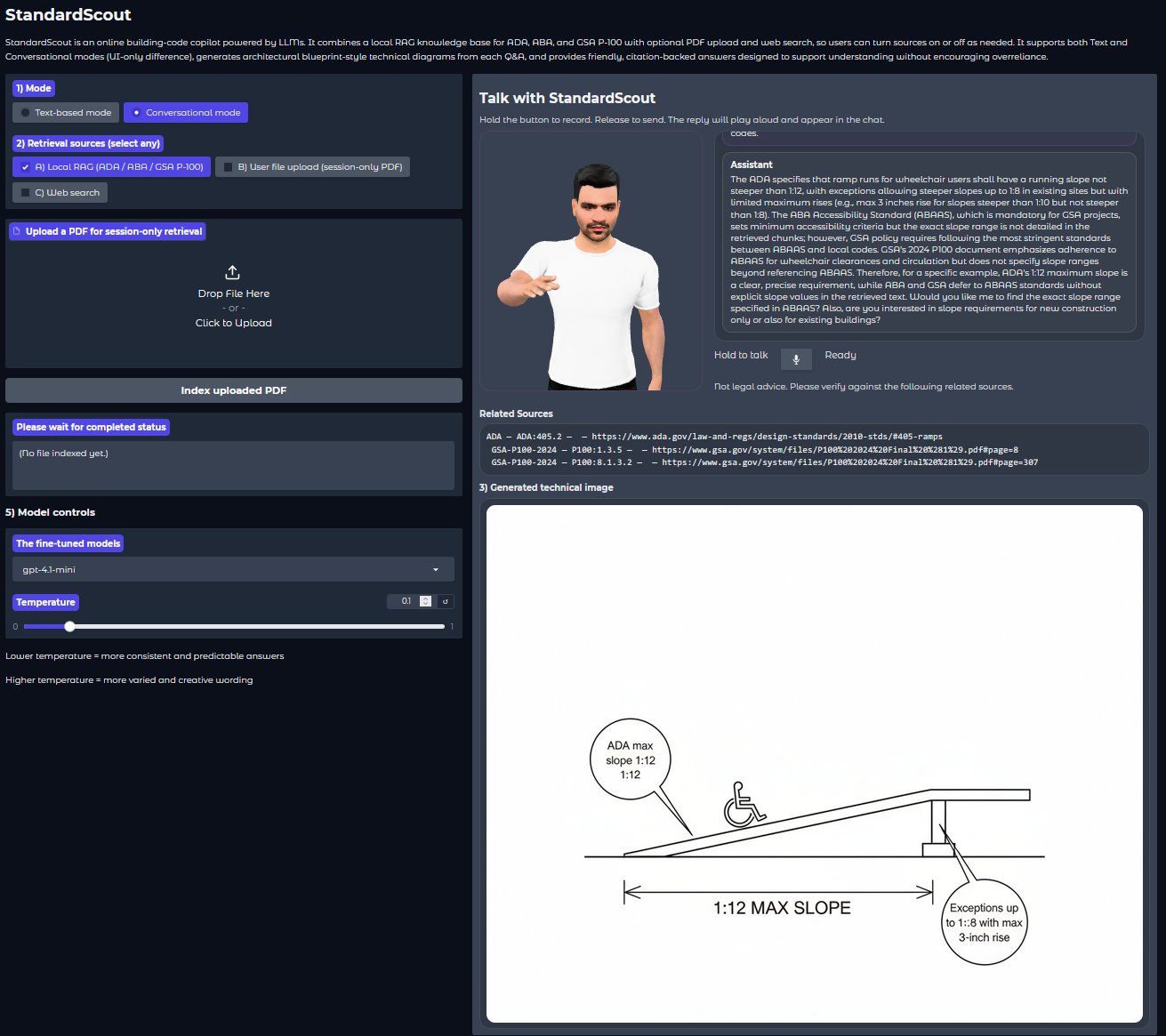
StandardScout is an online building-code copilot powered by LLMs. It combines a local RAG knowledge base for ADA, ABA, and GSA P-100 with optional PDF upload and web search, allowing users to enable one source or combine multiple sources depending on the task. Uploaded PDFs are stored only temporarily for the active session.
StandardScout supports Text and Conversational modes. Each Q&A generates a simple blueprint-style technical diagram and returns friendly, citation-backed answers designed to support understanding.
RAG (local + optional web)ADA + ABA + GSA P-100Text + Conversational UIBlueprint diagram generationFine-tuned response tone
Project at a glance
What problem it targets
Building codes are dense and cross-referenced. Designers need answers that are fast, accurate, and traceable back to sources.
Goal: reduce search friction while keeping evidence visible
Constraint: avoid hallucinated guidance and overtrust
Audience: architects, students, and AEC practitioners
What I built
Local RAG over ADA, ABA, and GSA P-100 sections
Optional user PDF upload for project-specific documents
Optional web search to bring in public references when needed
Two UI modes (Text and Conversational) with identical logic
A blueprint-style diagram generation per Q&A
Core tech
LLM: OpenAI GPT-4.1 mini (tone-tuned)
Retrieval: local RAG for standard documents
Training: fine-tuning and QLoRA workflow for style control
Output: blueprint-like vector diagram generation
Privacy: uploaded PDFs are stored only for the session
How it works
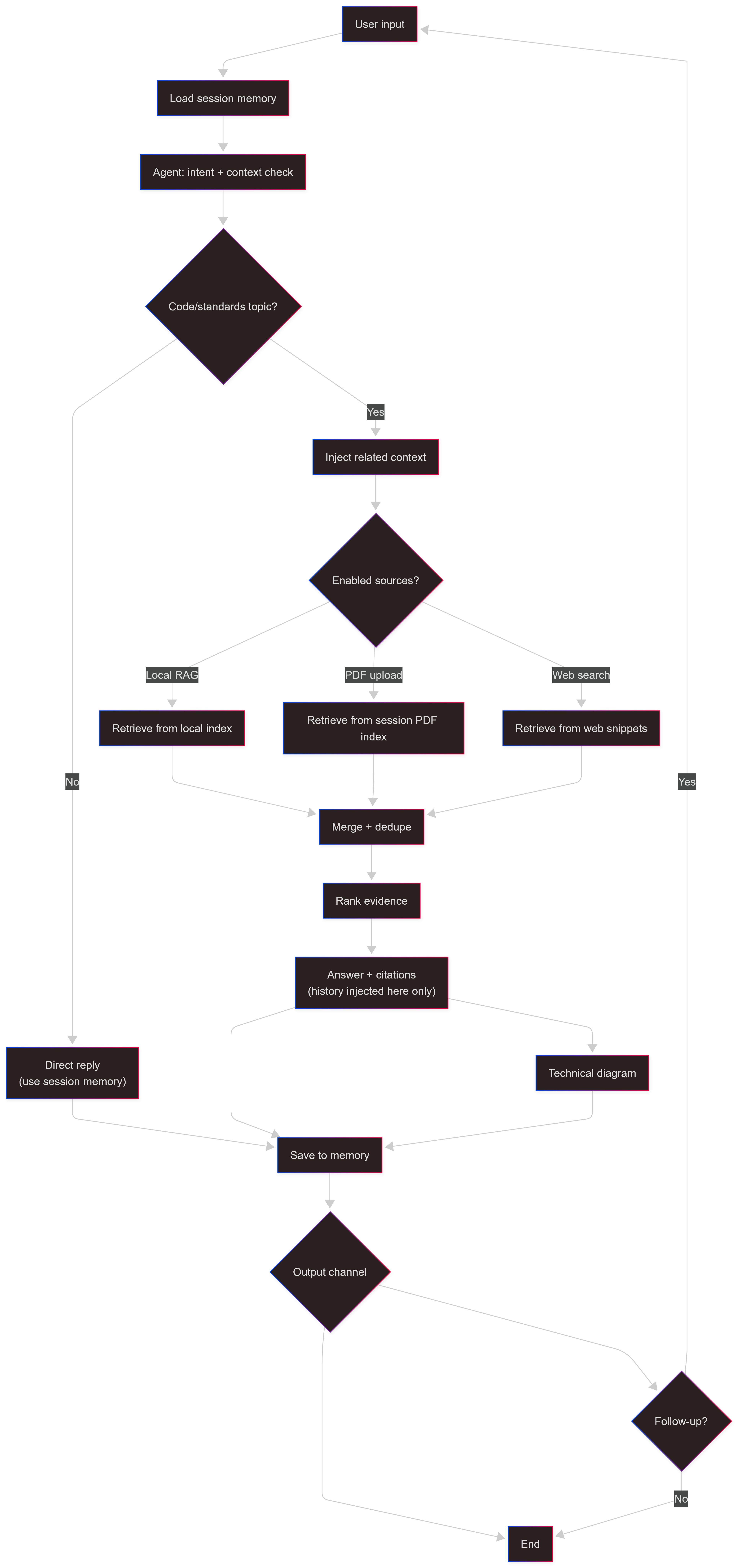
StandardScout is built around a source-aware workflow. Users decide which evidence streams are active, and the assistant returns an answer that is tied to the activated sources.
System overview: local standards retrieval plus optional user documents and web search, followed by citation-backed answers and blueprint-style diagrams.
Demo
Try StandardScout below and explore the source toggles and response citations.