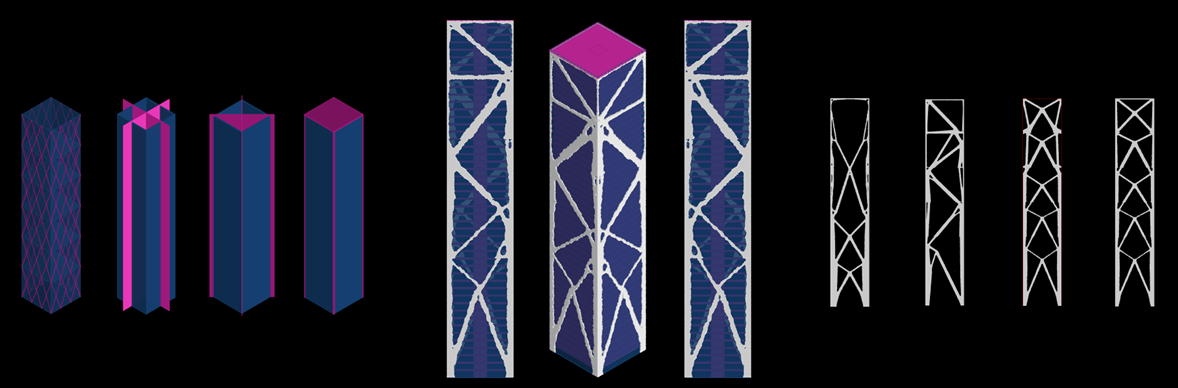
Parametric topology optimization of high-rise structural systems.
Topology · Parametric · Structures · 2021
Summary
BESOLOGY is my 2020 master’s dissertation project that integrates parametric design with BESO topology optimization to generate efficient and expressive exterior bracing systems for tall buildings. The workflow couples load generation (wind + gravity), finite element analysis, and iterative add/remove logic to explore structural forms that are both lightweight and architecturally legible.
Rhino + GrasshopperBESO (Ameba)WS-Snake wind toolFinite element analysisHigh-rise lateral system
Focus: exterior lateral bracing for tall buildings under wind and gravity loads
What I built
A Grasshopper-based workflow that links geometry, loading, analysis, and optimization
WS-Snake: a custom wind-load component that converts code-based pressures into nodal forces
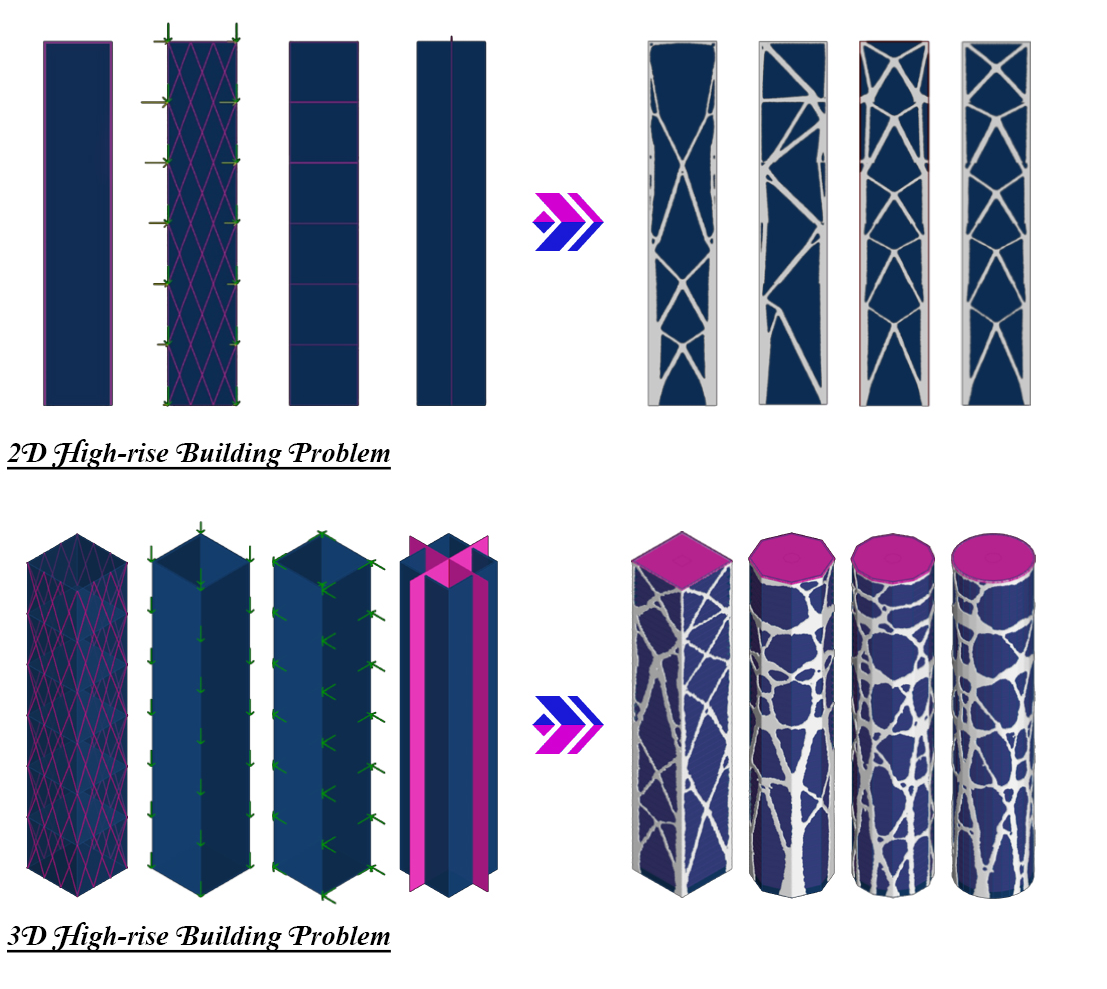
A repeatable setup to study 2D and 3D high-rise bracing problems across multiple load cases
Problem and goal
For tall buildings, designers must balance stiffness (to resist wind and lateral drift) with weight (to reduce material use and cost). Exterior bracing systems such as diagrids can be structurally efficient, but selecting a bracing layout is often a slow loop of manual modeling, analysis, and redesign.
The goal of BESOLOGY was to create a designer-friendly, parametric framework that lets architects and engineers quickly explore a family of exterior structural systems, while keeping the analysis and loading logic explicit and repeatable.
Method overview
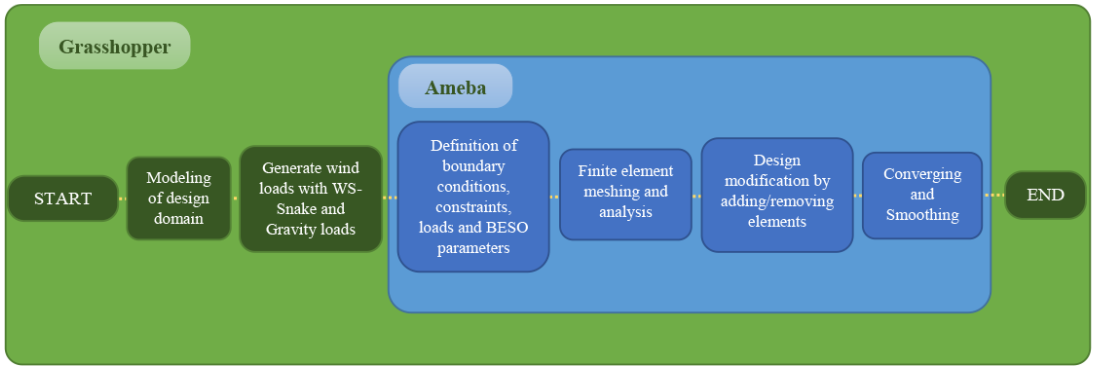
The core idea is to treat the exterior bracing as a design domain and apply bi-directional evolutionary structural optimization (BESO) to iteratively remove inefficient elements and add efficient elements until the design reaches a target material volume (or stiffness objective) under the selected load cases.
High-level workflow: model the design domain, generate wind + gravity loads, run FE analysis, apply BESO add/remove steps, and iterate to convergence.
Grasshopper (parametric layer)
Geometry definition of the bracing domain and constraints
Parameter control (module size, symmetry, resolution, target volume fraction)
Automated load mapping (wind + gravity) to analysis nodes
Ameba (BESO + analysis layer)
Finite element meshing and analysis per iteration
Sensitivity-based add/remove logic (BESO)
Convergence checking and smoothing/post-processing
Outputs
Families of bracing patterns for different load cases and volume fractions
Comparative results for 2D vs 3D problems
Conceptual tower form studies and visualization
WS-Snake wind-load tool
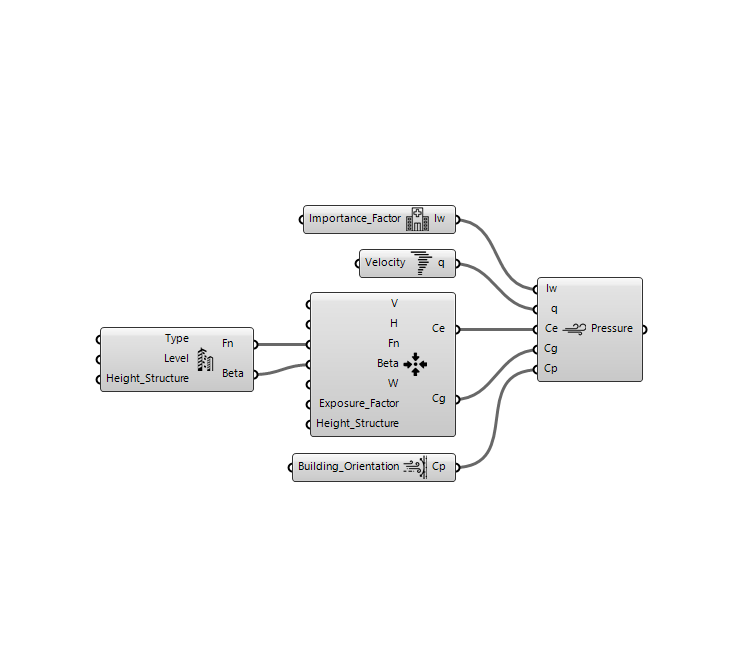
To make wind loading practical inside a design workflow, I developed WS-Snake, a Grasshopper component that estimates wind pressure and suction values and distributes them as nodal forces on the façade. The tool follows a code-style workflow (e.g., exposure, height effects, and directionality) and supports studying how different building orientations and forms affect loading patterns.
What it does
Takes wind speed, exposure, building height, and orientation as inputs
Computes pressure coefficients for each façade segment
Outputs nodal forces that can be fed directly into the FE model
Why it matters
Brings wind loading into early-stage parametric exploration
Reduces manual translation between code tables and analysis software
Makes load assumptions transparent and reproducible
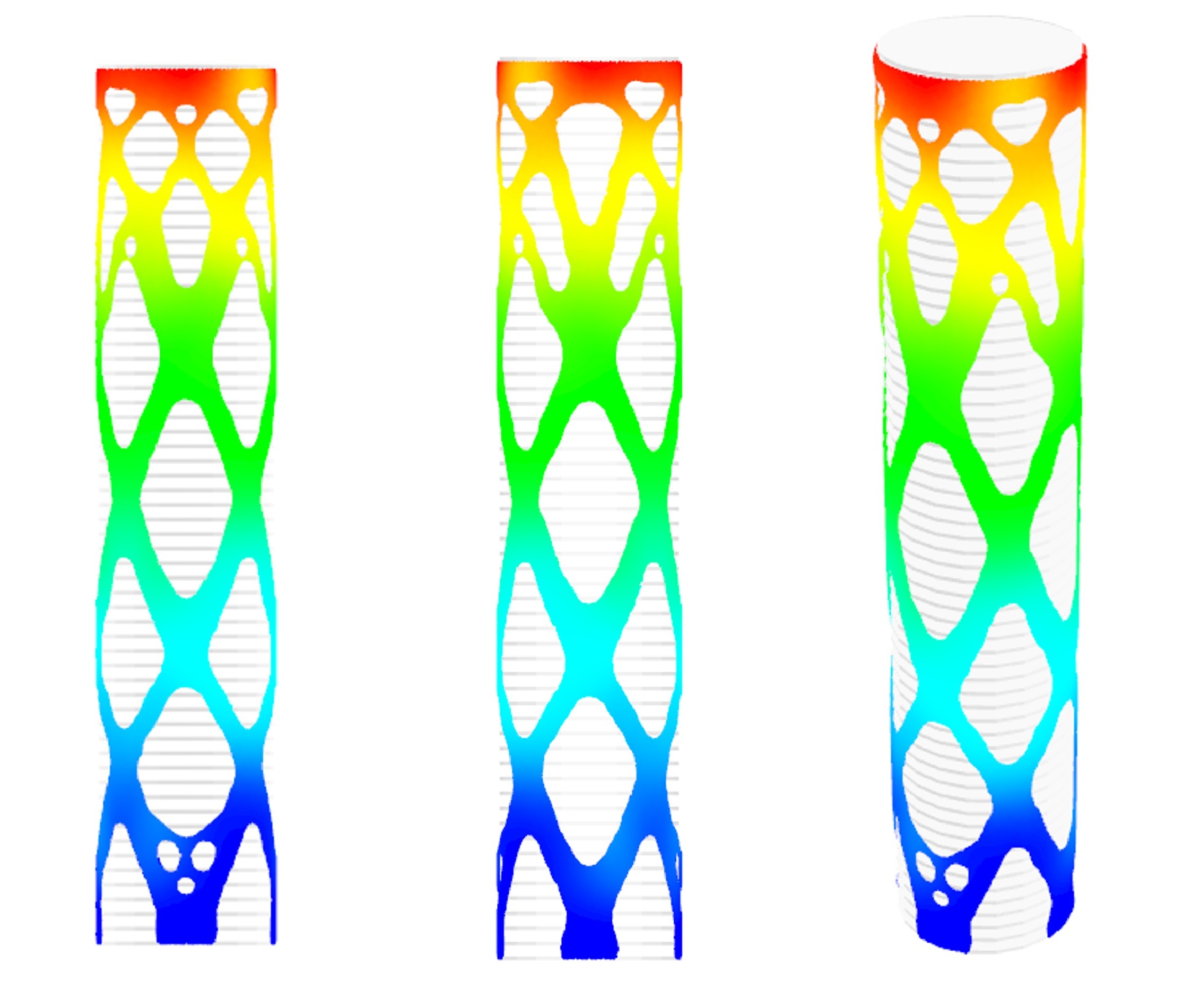
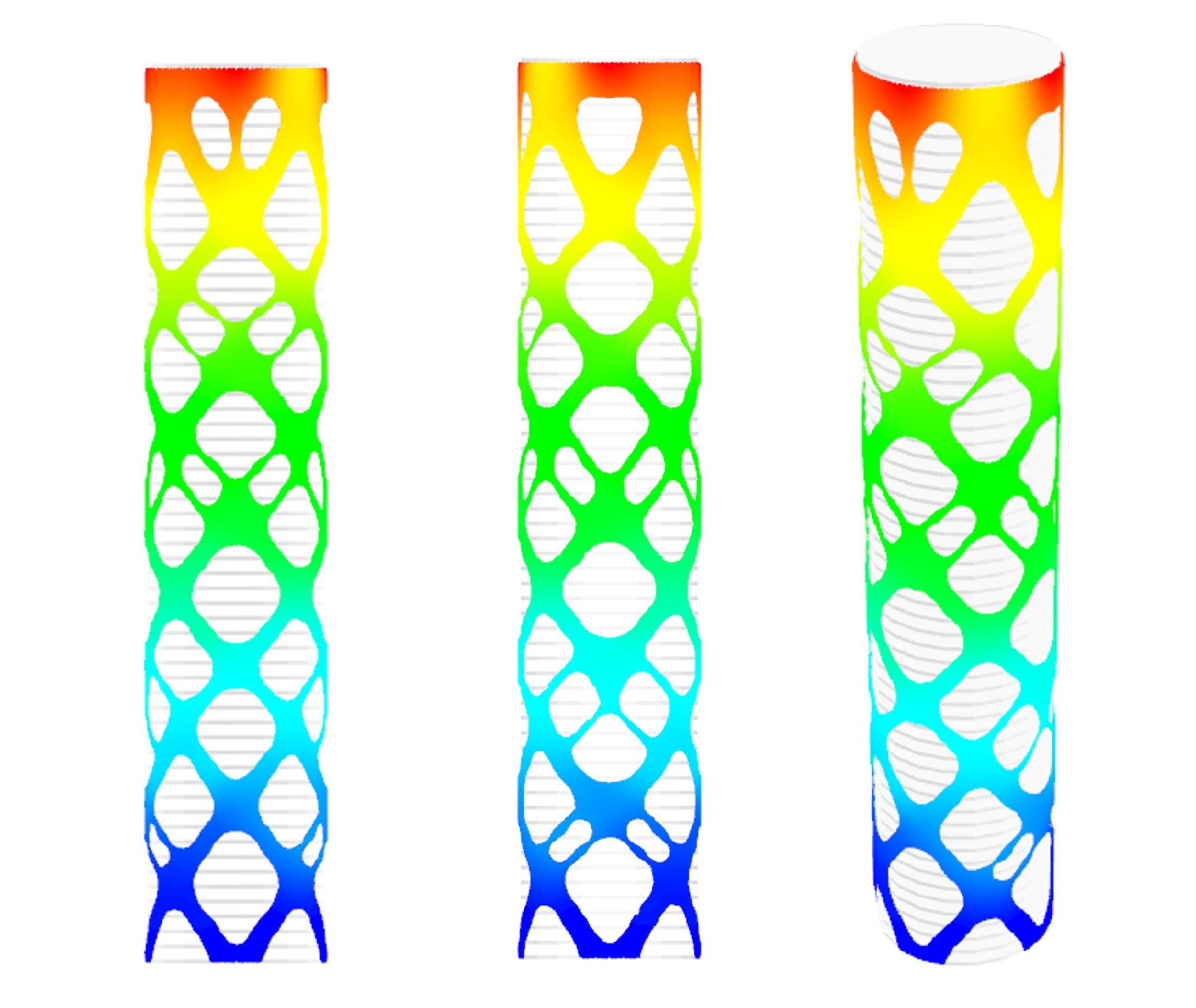
WS-Snake definition: inputs for exposure, velocity, and building orientation feed a pressure output.2D and 3D high-rise problem setups and example optimized patterns.
Case study setup
One of the main studies uses a simplified tall-building case to evaluate the workflow under realistic combined loads. The exterior system is treated as the optimization domain, while gravity and wind loads are applied through the automated pipeline.
Geometry
48 stories, 4 m story height
36 m × 36 m plan, 192 m total height
Exterior diagrid domain divided into modules (module angle ≈ 69°)
Optimization control
BESO iterates by adding/removing elements based on sensitivity
Targets different material volume fractions to study performance vs weight
Post-processing smooths voxel-like boundaries into buildable geometry
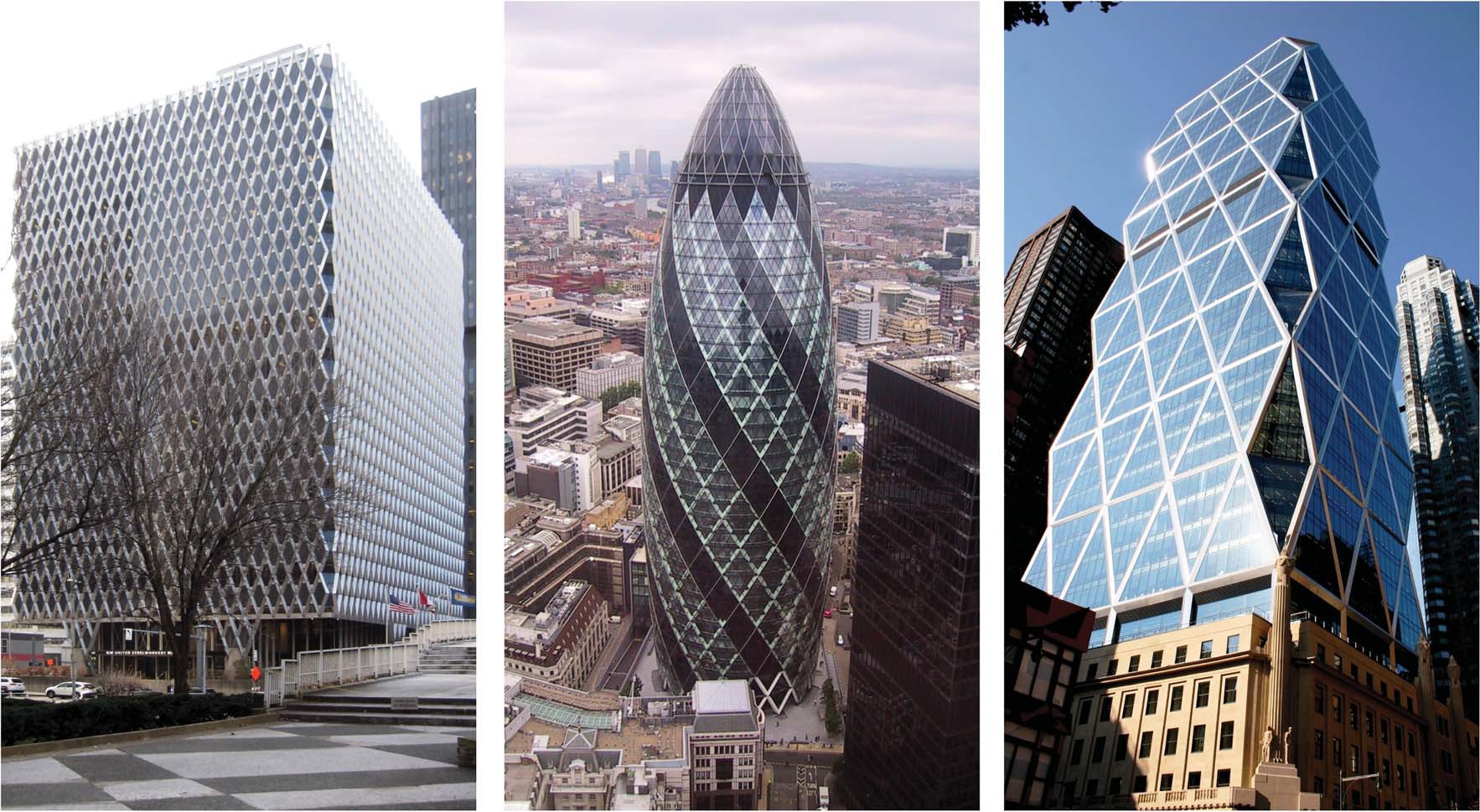
Precedent inspiration: diagrid and exoskeleton typologies motivate an exterior structural system that is both efficient and visually legible.
Results and design exploration
The workflow produces a family of bracing patterns, not just a single answer. By changing volume fraction targets, boundary conditions, and load combinations, the system reveals how structural logic “wants” to organize itself across the façade.
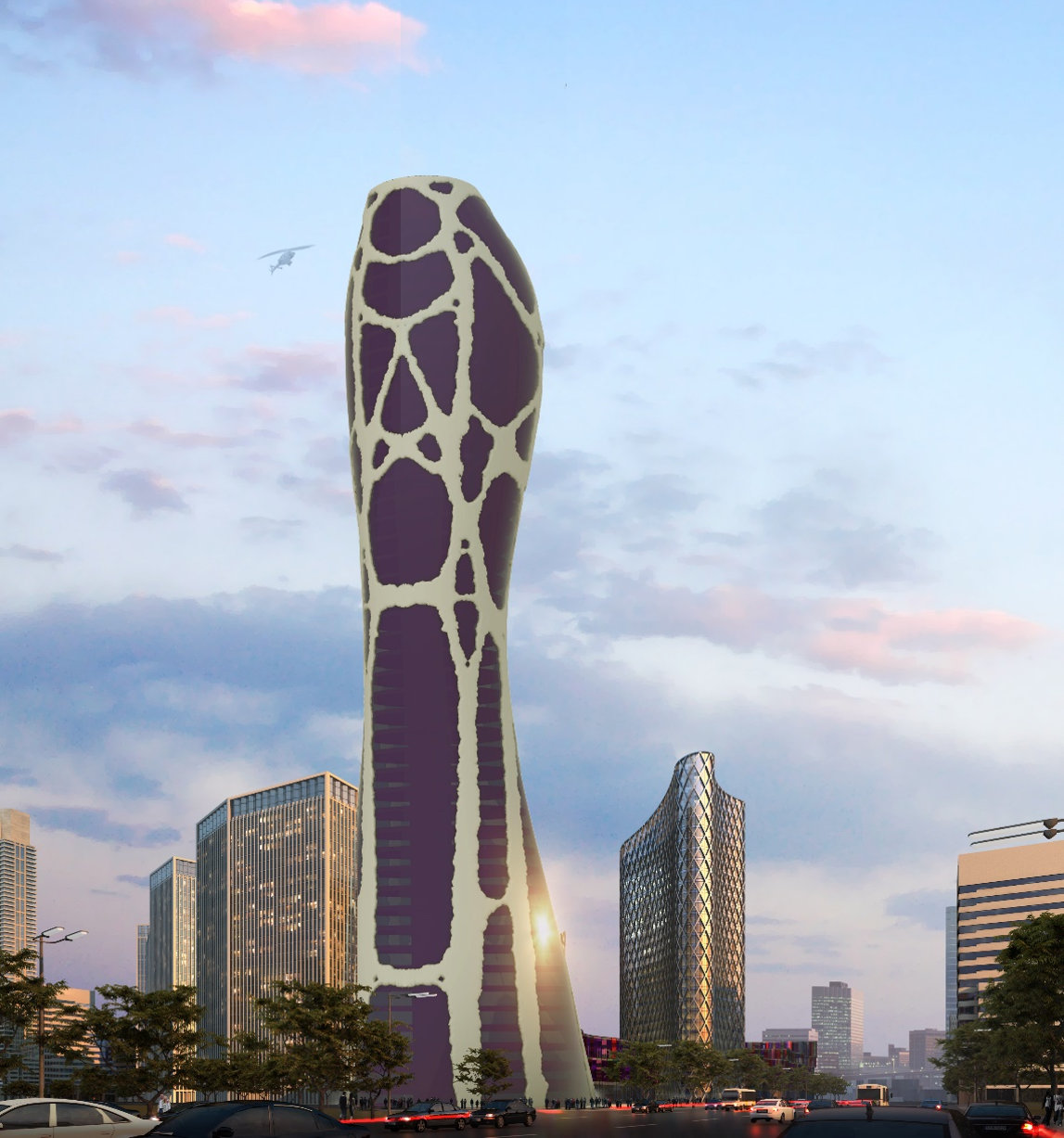
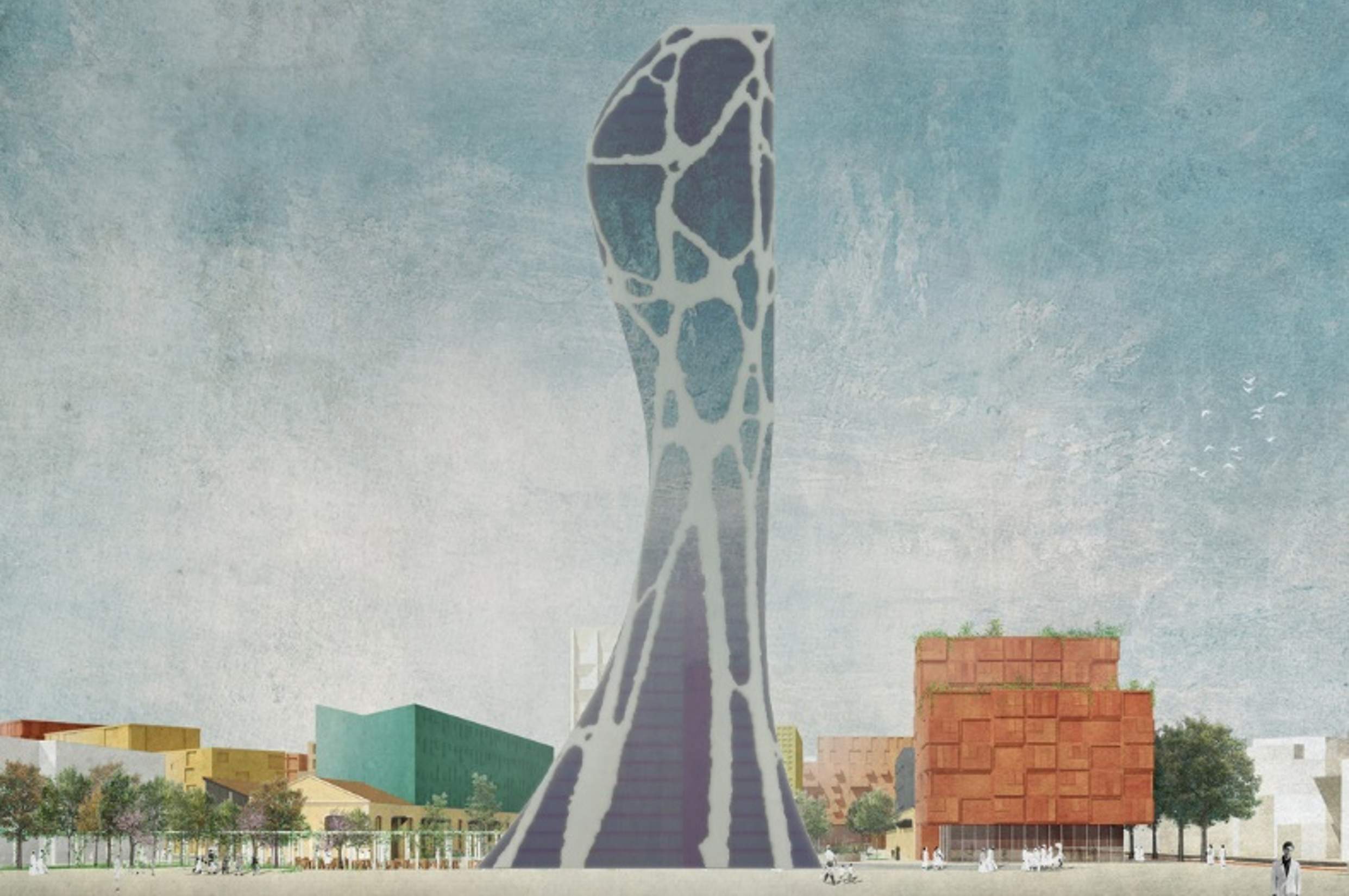
Concept render: translating an optimized exterior system into an architectural high-rise proposal.
Form finding (aerodynamic study)
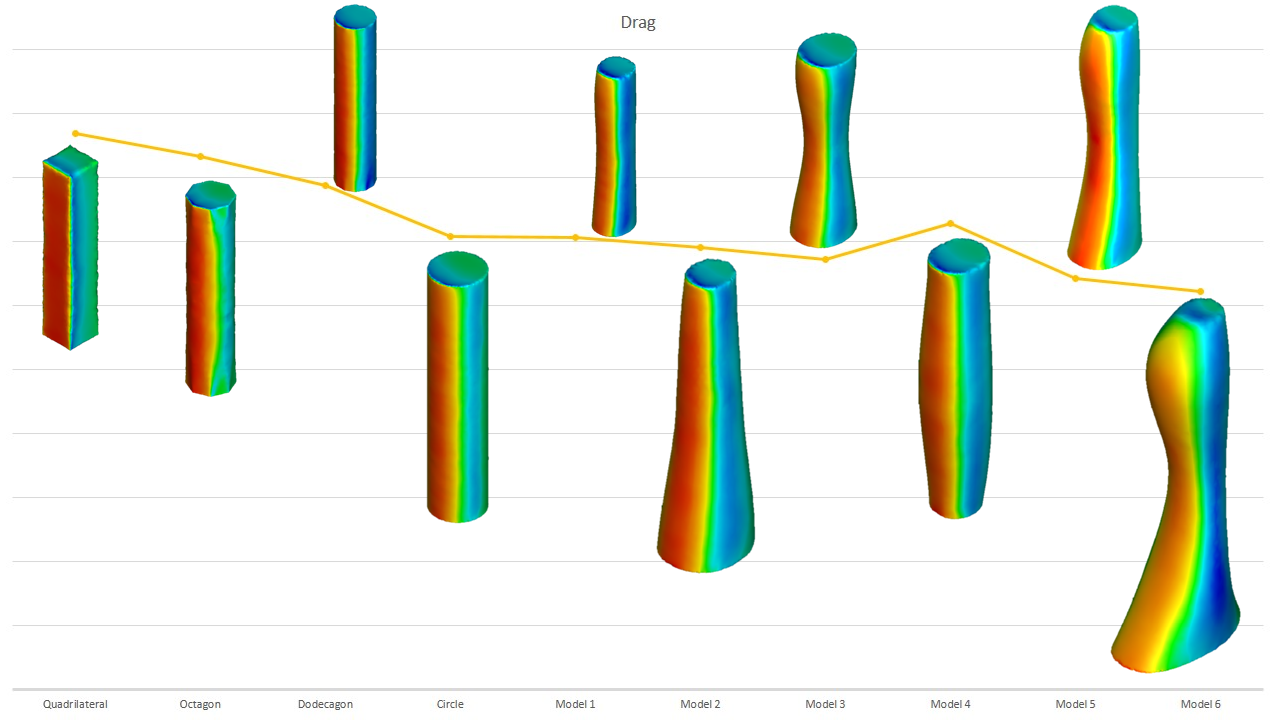
Beyond bracing topology, I explored how overall tower form influences wind response. A set of parametric massing options were compared using CFD-style analysis outputs (e.g., drag trends) to understand how geometry can reduce wind demand before structural optimization even begins.
Form-finding: comparing alternative tower silhouettes and their relative aerodynamic behavior.Visualization of one of the explored forms.
Key contributions
Integrated pipeline: a single parametric loop connecting geometry, code-style wind loading, FE analysis, and BESO optimization.
Designer-facing wind loading: WS-Snake reduced friction in applying wind pressures to early-stage models.
Exploration mindset: the system produces families of solutions, enabling informed structural and architectural decisions.
Buildability awareness: smoothing/post-processing steps bridge raw optimization outputs and realistic structural detailing.
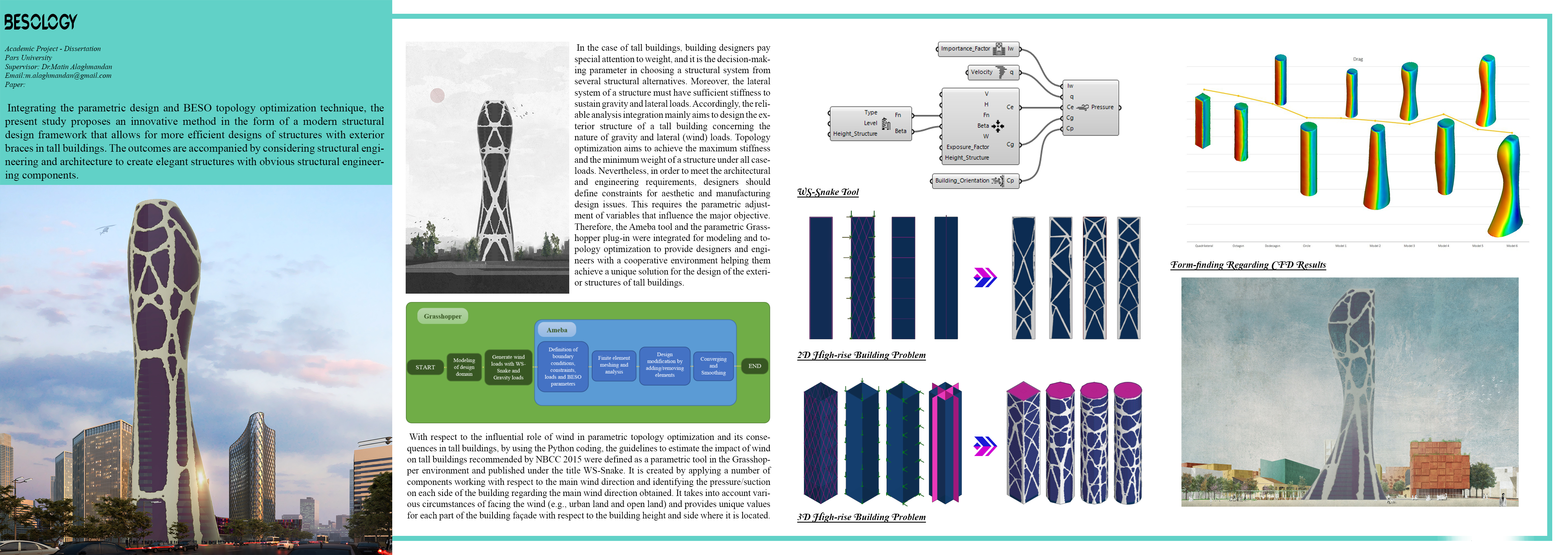
One-page portfolio
Tip: open the full-size version to read the diagrams and captions.